

This means the design of procedures, processes and building spaces, to guide people’s behaviour in the desired direction.
Behavioural design is possible because our brain responds to a wide spectrum of input signals, most of which we never consciously notice. By modulating this input, a surprising amount of influence can be attained. Which often is far more effective than direct instructions, requests or information.
An example of the simplest form of behavioural design:
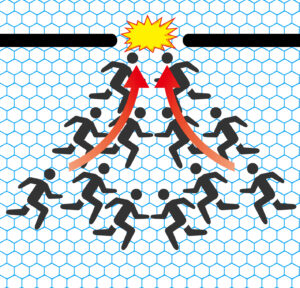
In a crisis situation, many people want to flee through the emergency exit simultaneously. This can cause jostling, trampling and injury. (See the image on the left.)
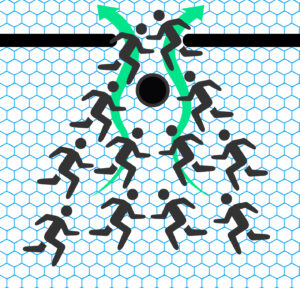
Signs with instructions, arrows on the floor or regulators issuing directions turn out to have hardly any effect. But research showed that a simple pillar placed directly in front of the exit solved the problem. As this splits the mass of people into two separate flows, which come together smoothly at the exit. (Right side image.) This one added element, makes further regulation unnecessary.
Behavioural design can be applied to a wide range of processes and procedures, in which there is a desire for more control over responses.
Please contact us for more information about the possibilities.